
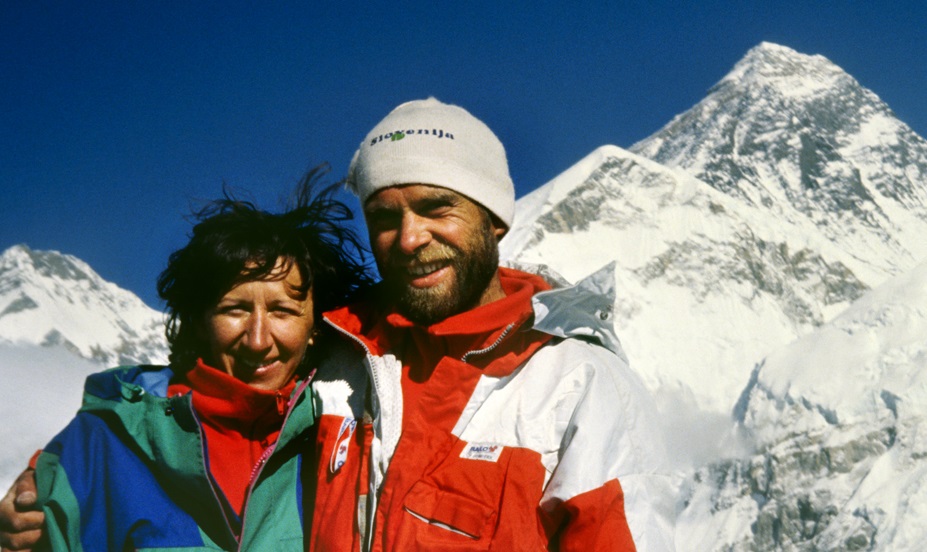
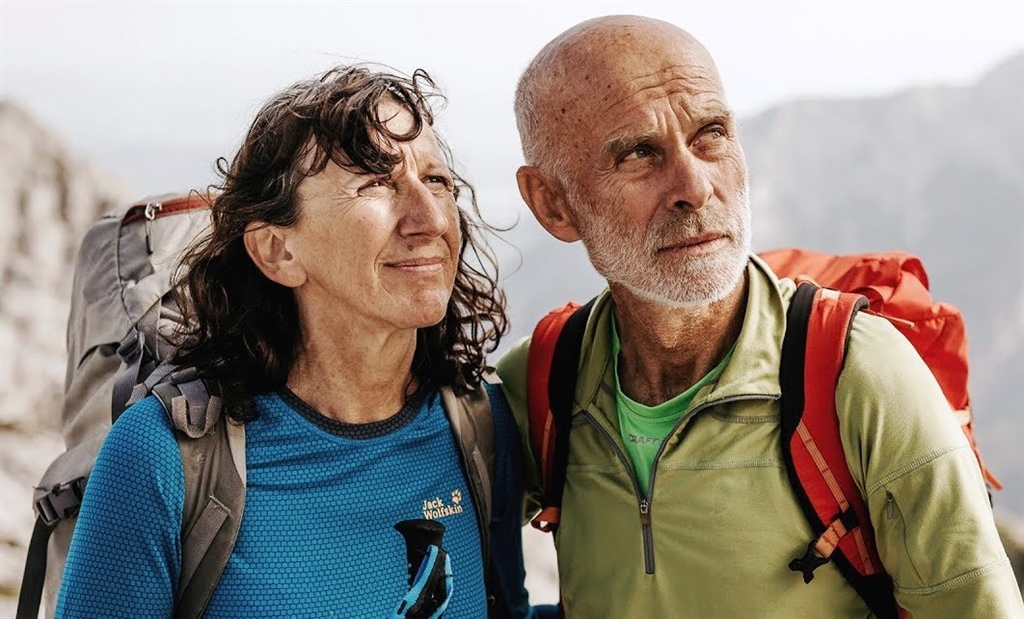
Maria and Andrej Stremfelj are one of the most famous couples in the world of climbing. 50 years in the mountains and together. In 1990 they became known as the first married couple on Everest. Andrej received twice the most prestigious award in climbing, in 1992 "Piolet d'Or" for the ascent of the eight-thousander Kanchenjunga-South (new route, S Ridge, alpine style), and in 2019, "Piolet d’Or Lifetime Achievement". Both with Maria are IFMGA mountain guides, guiding people in the mountains for decades, including on the most difficult terrains. They say that despite the many years, they are more in love with each other now than they were when they were 18 (when they met).
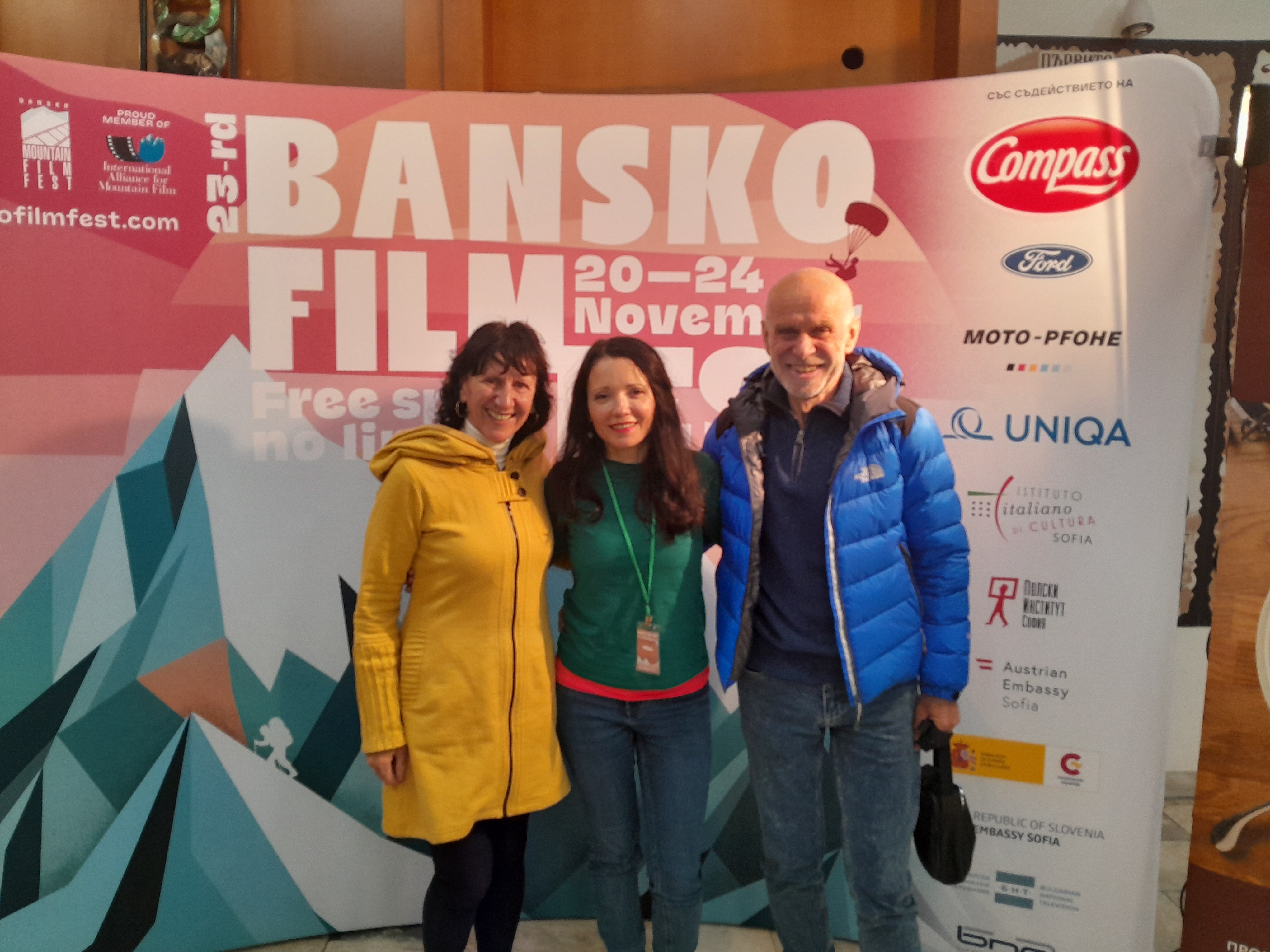
Last month, Andrej Stremfelj was an official guest of the Bansko Film Fest, accompanied by his wife. A few months earlier we did an online interview with him (you can read and listen to it here), and in Bansko we talked again, this time with Maria.
Yesterday, at the presentation, I was behind you, Mrs. Stremfelj, and I saw you smile constantly as you looked at your husband on stage. How do you manage to maintain that after so many years in high-stress situations on the mountain?
Maria: When I met Andrej, I was a girl, he was a real climber and I knew that if I was with him, that would not change. After we got married, there was a point where I had to decide whether to stay with him. It was clear that the mountains would be a very important part of our life. But they were an important part of my life as well. I was in love with Andrej, as I am now. We even sometimes say that we are more in love with each other now than we were in the beginning of our relationship. So many things happened, we have so many memories. Trust is most important. He went on an expedition every year, and if he missed a year, he went on two expeditions the next. And when he came back it was like a honeymoon every time, it was so good to have the man I love home again. As well as for the children. They appeared quite soon, when I was 24, our son Luka was born, and two years later our second child was born, then the third. Our children were also very happy when Andrej returned from an expedition, because when he was home, he was home in the true sense of the word, he spent a lot of time with us. And even after I gave birth to the children, I didn't stop climbing, maybe because Andrej was understanding, knew how much I loved it and didn't expect me to stay at home.
Andrej: First, we love each other, and we both love the mountain, that's very important. When I was too focused on the mountains, Maria was the one who reminded me that we have a family, and that's the reason I'm still alive, because I was so crazy that I wanted more and more and more... She was my harbour and I always loved coming home.
They met when they were 18 years old. Maria is the ninth child in the family, and Andrej often visits one of her brothers.
Maria: My brother was a climber, he climbed with Andrej. He was the chairman of the alpine club in our town, Kranj. Often after a club meeting the boys came home. I was interested in hearing what they did, looking at their pictures. Andrej was already very famous, he had an important place in the alpine club, in my eyes he stood high, he had already climbed many routes. Then Nejc Zaplotnik saw in him a future legend, saw in this young boy how much he loved to climb and began to take him on more difficult ascents, then to the Himalayas. At that time I was a beginner, Andrej was the star. These guys didn't want to climb with the beginners and I started going with other friends, with time I got better and better, I started to be interested in more difficult routes and became interesting to Andrej.
Andrej: Her brother is 5 years older than her. I've been to their house before I met Maria and every time I went to see Tone, that's her brother's name, he kept introducing me to one of his brothers or sisters, and I got confused who was who in their family.
Maria: I think people meet for a purpose, not by accident. It's like that with everything in life. I should have met Andrej.
Andrej: We were born for each other.
Maria: Yes, I think so too.
In 1990 Maria and Andrej Stremfelj became the first married couple to reach Everest.
Maria: I don't think it changed us much. We both had jobs, we weren't professional athletes. I was a biology teacher, and Andrej was a teacher of sports. After Everest, it was easier to take vacation to go to Nepal. Climbing season in the Himalayas is usually during school time and it is impossible to take time off, but we had become famous and had the necessary class in the sport to allow us to do so.
However, being famous has never been important in our lives. We never had many sponsors. We didn't want to because it was more important to be free. We didn't have a lot of money, it all went to climbing, to travel, to expeditions, to equipment... But still, our life was good - we had enough to live on, enough for the things we love. This is perhaps part of the answer to your first question too - we are in such a relationship because sponsors occupy a person, make him separate from his family for a long time, set goals that are perhaps too high...
He didn't have that pressure to perform, he didn't have any worries about whether he would succeed or not. That energy was about family, not about what the companies would say.
Andrej: Sponsors always want something even more difficult, more complicated, so if you don't have sponsors, you are free. If someone sought us for an interview, we responded, of course, but we did not seek the media. We haven't had that pressure to live up to the expectations of sponsors, to have a lot of media presence, etc. I never sought fame. I just climbed because I liked it.
Maria: That way we could be free. Andrej could do what he believed in, what he could and wanted. After we climbed Everest, there were a lot of articles about us, a lot of shows, a few months later the interest started to wane. When Andrej received the first "Piolet d'Or", there was great admiration, again great interest, but again - "every miracle, in three days". But for us, that was fine. Interesting, but now, while we are talking with you, while we are trying to answer your question, I am discovering something new about myself, about us, with Andrey. We never talked to him about this influence of media, sponsors, fame on our lives.
In 1992, Andrej Stremfelj and his partner Marko Prezelj received the most prestigious award in climbing - "Piolet d'Or" for their alpine-style ascent of the eight-thousander Kanchendjunga - South, via new route along the southern ridge. In 2019 Stremfelj received a second "Piolet d'Or" – for lifetime achievement. Only 9 people in the world received the award before him.
Maria: When he got older people learned what he had done in climbing. Messner said Andrej was perhaps one of the five climbers who changed the philosophy of Himalayanism.
Andrej: It was very interesting when we climbed Kanchendjunga with Marko Prezelj, then a tragedy happened, two people died in the same expedition, but on a different route. For the Slovenian media, our ascent was not important. After a year, when we received a "Piolet d'Or" for it, then did they notice it.
Both Maria and Andrej are IFMGA mountain guides.
Maria: Andrej has been a guide for over 40 years - a long time. We have 3 kids, we go to work, we have a family, and one of us had to be "normal" because of the children - take them to school, take care of them. When they got older, I took my son and his friend to Mont Blanc, they were 18, at the end of high school. I wasn't a guide then, I just took them and there I found that his friend had never put crampons on his shoes, and my son had a problem with height, it turned out that he couldn't stand it. I had no knowledge of how to deal with this situation - at a high altitude, until then I had always been in the mountains with experienced people. Now I did not know what to do with the two young men. We managed to climb to the top and to come back, but it was a very difficult moment for me. I realized that I needed new knowledge. And when the children grew up, I had more time, I wanted to guide people, I liked it, I was 47 and I started this long and difficult training to be an alpine guide. Sometimes I wondered why I did this, but it's okay now.
In their long alpine career, the two experienced a number of moments in which they saw their lives "on the edge".
Andrej: When we descended from Dhaulagiri in 2005, there were three of us, the upper part is not so easy, we were a small expedition, without porters, above camp 3 we did not fix ropes, here and there there were remnants of old ropes, we climbed practically without fixed ropes. On the way down, exactly a meter before Maria could hang onto one such old rope, she slipped and began to slide down… It is much more difficult to watch such a thing, to watch a man fall, than to be in his position. I thought that was the end… It was too icy to use the Ice Axe, it was steep and the slope was maybe 200-300 m and down another 2000 m drop. Somehow, however, she stopped at a rocky place. At about 7,500 m and even higher this happened. Then we managed to get down to the base camp.
In 2009 the two survive an avalanche while a movie is being made about them.
Andrej: They were shooting a film about us in the Julian Alps. We are not used to being in the role of actors, being told – stand here, do this, let's do it one more time, etc. In all this commotion, we forgot that we were still in the mountains and not on some stage, we didn't pay much attention to what was happening around us. It was sunny, it warmed up and all the snow above us became unstable, 20 cm of new snow had fallen the day before. A huge avalanche fell. It pulled us 300 m. We had no avalanche equipment. Only the camera crew was nearby. It overwhelmed us up to our chests, our heads – no, and we escaped.
In 1979 Andrej Stremfelj and Nejc Zaplotnik became the first people in the world to climb Everest along its West Ridge in its entirety.
Andrej: I slipped on the way down, in the Hornbein Couloir. My backpack got caught on a rock and I fell down the slope. However, I was strong enough to spin around and hold my Ice Axe in the firn. Two days later Sherpa Ang Phu was not so lucky.
On the way down from the top Stipe Bozic, Stane Belak and Sherpa Ang Fu have an accident. The Nepalese man slips but fails to hold on with his Ice Axe, falls 2000 m to the Rongbuk Glacier and dies – just a day after becoming the first person to climb Everest by two different routes (the first time was in 1978, together with Wolfgang Nairz, on the normal route, as part of the famous Austrian expedition in which Reinhold Messner and Peter Habeler made the first ascent of Everest without supplemental oxygen).
I ask Maria and Andrej how their children reacted to their risky experiences in the mountains. Didn't they try to stop them?
Andrei: We haven't explained much to them about what's happening to us.
Maria: They didn't know what it was about (laughs).
The Stremfelj family were in Bulgaria with their friends, not mountaineers, but musicians. They say it helps them occasionally shift their focus outside of climbing and mountaineering. To travel and talk about other topics.
The following message was addressed to the young climbers:
Maria: They don't need to get high quickly. The mountain requires you to get to know it step by step. I lost my sister there, I know how dangerous it can be. Lately it's also dangerous from the point of view that someone who is good at sport climbing, sends 7a, for example, and expects it to be the same on the mountain. And it is not. It's not just about climbing a wall - before that there's an approach to it, then you have to get down, be lucky with the weather, know how to secure yourself. And this desire to quickly become better, to quickly reach the high - the mountain does not tolerate it for long.
Andrej: It's important that people climb for no other reason than because they enjoy it. Not to take nice pictures or brag about it.
Maria: I am very glad that young people go to the mountains, but it should be with respect and love for the mountains. I want to tell women too – don't stop with it after becoming a mother. There are suitable routes that are not so dangerous. It is possible to be both a mother and a climber.
Tanya Ivanova's interview with Maria and Andrej Stremfelj was broadcast on the program "Night Horizon" on the Bulgarian National Radio on December 28, 2024. You can hear it in the sound file above.
===
If you like what I do, you can see the "If you want to support me" section in the main menu of this site. Thank you!
Gallery
Leave a comment