
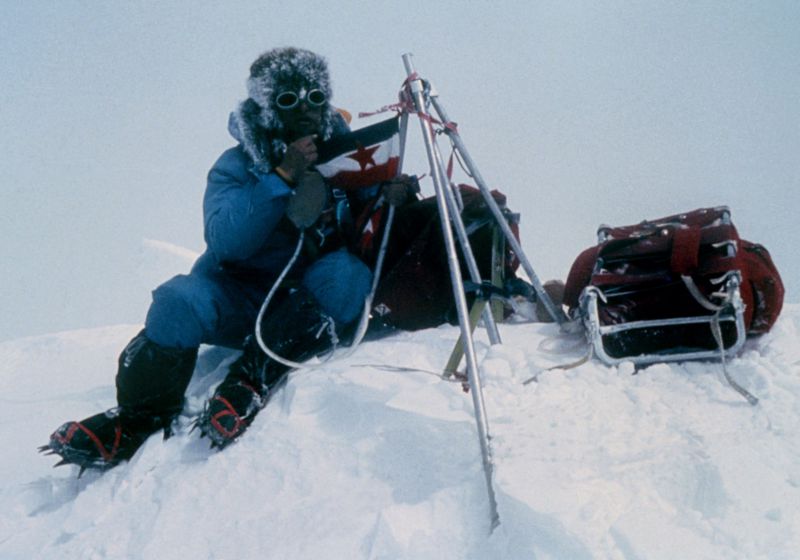
We did this interview (for Bulgarian National Radio) with the legendary Slovenian climber on the occasion of 40 years since the Bulgarian expedition to Mount Everest. In 1984, five Bulgarian men climbed it via the West Ridge. They followed the route of the Yugoslav expedition of 1979, and on the descent they passed from the SE, thus making the first complete traverse of Everest, which has remained in history as the Bulgarian traverse.
Before the Bulgarian climbers, the most difficult route to Everest - the West Ridge - was completely completed by only two people, the Slovenians Jernej "Nejc" Zaplotnik and Andrej Stremfelj. Both are climbing phenoms, but Zaplotnik died in an avalanche 4 years after Everest while attempting to climb the South Face of Manaslu. Stremfelj developed a dizzying career that included:
* 3000 climbed routes worldwide;
* 9 times successful ascent of eight-thousanders (including Everest twice), 3 of them - on a new route, 3 eight-thousanders reached in pure alpine style;
* steps on 3 previously unclimbed seven-thousanders - Nyanang Ri, Menlungtse, Janak Chuli, in alpine style, on a new route climbs Gyachung Kang - one of the highest seven-thousanders, 7952 m.
He climbed his first eight-thousander, Gasherbrum I, before he turned 21, on a new route (West Ridge). Two years later he made the historic first ascent of the West Ridge of Everest (new route) - with Zaplotnik. Next came Broad Peak, Gasherbrum II, Shishapangma, Kanchenjunga-South, Cho Oyu, Dhaulagiri and again Everest.
For these achievements, he received twice the most prestigious award in climbing - in 1992 "Piolet d'Or" for the ascent of the eight-thousander Kanchenjunga-South (new route, S Ridge, alpine style), and in 2019 - "Piolet d’Or Lifetime Achievement". Stremfelj is an IFMGA mountain guide with over 40 years experience in alpinism.
Here is my interview with him
When did you feel more satisfied - when you got the Piolets or when you reached an unclimbed peak?
Stremfelj: Oh, this is a difficult question. I think I have been most satisfied on the summits, for example Kanchenjunga. But, you know, when you're in the highest mountains, you always worry that you can not be happy for long. Maybe 5 minutes and then you have to think about how you're going to get down, how your partner is going to get down if he's exhausted, what's going to happen to the weather if night comes, if you don't know the way down, etc. But when I got the "Piolets d'Or", especially the second time, you know - the warm hall, it fills stomach... The feeling was also great, I have to say. The first "Piolet d'Or" was for the best climb of the year, but it's a completely different thing to get "Piolet d’Or Lifetime Achievement".
You climb all your high peaks on new routes or in alpine style. I wonder if you still feel that fever of discovery, the desire to venture into the unknown, to be the first.
Stremfelj: The big reasons why I have been so long in climbing and mountaineering are 3. One is the beauty of nature that you meet. This is why I started to climb and go to the mountains. The second is the adventure, because every climb is an adventure, especially in the high mountain, in alpine style, on a new route. On 3 seven-thousanders I made their first ascent. It's also a special feeling... The third reason is exploring. Especially new routes and unclimbed peaks, that's one of the main things that brings you to these ascents.
And now, 40 years later, do you feel ready to take the same risk?
Stremfelj: Probably not the same. With the years you get older and you are not prepared to risk anymore so much. But I still like risk because this is a part of climbing and mountaineering.
In 1979, when you reached the summit of Everest with Zaplotnik, your message to Base Camp was: "We are on the Chinese pyramid and we don't know what to do." What did you mean, you were giddy with success, with fatigue? Do you remember?
Stremfelj: The time to enjoy the summit is very, very short. The last meters to the summit and the first minutes on the summit, the warm feelings in the heart... It is no longer necessary to take more and more steps up. It's over... The feeling is so short. On Everest, we didn't think about coming down, because such thinking could easy lead us to abandon, we would start thinking about how hard it is, how fast time is moving, wouldn't it be better to go back... We left that to think after we reached the top, and there we had to start thinking about the descent very quickly. That's the reason why we said such a sentence (the message to Base Camp), it was not a learned sentence, it came from the heart in that moment. We were together for almost 3 months during this expedition, in the evenings we talked to each other about a lot of things and most often someone said - I would like to reach the summit, I am prepared to loose one finger on my right hand only that I come to the summit, or - I can loose all my toes only to go to the summit. We prepared for the risk, but we never talked what we would do with the view of the summit.
And when we got up, we said: "Now what? This is the summit. This is the end". We were a little bit "lost". After that the leader of the expedition (Tone Shkarja) said: “Okay. Make sure you take lots of photos at the summit, on the pyramid, of yourself and go down as soon as possible”.
Then you climb the hardest route, the West Ridge. Can you describe it, what sets it apart?
Stremfelj: The first what is special for the West Ridge is that it is on Everest, the highest peak. We slept, our last camp was at 8150m - higher than half the other eight thousanders, and from this last camp you have to climb another 700m to the summit. The most difficult part is at high altitude, it is also the most technical part. Except for the wall of Lho-la, which is also difficult and steep (but located lower). And the last part we had to climb alone (solo), we were lucky that two members of our expedition, Marjian Manfreda and Viki Groselj, put the rope in the chimney (Manfreda Chimney), the first difficult section, but the last part we had to climb alone. There was one very difficult pitch on the Gray Step and it is rock climbing at about 8700 m altitude, really high!
Can we clarify something - after Mafreda Chimney did you turn left onto Hornbein Couloir or did you go straight up through the Gray Tower?
Stremfelj: We climbed it directly on the Gray Tower.
Because I saw a topo on Stipe Bozic's site and it draws a line going around the Gray Tower and going through Hornbein. That is, you and the other three men have gone through different places.
Stremfelj: After the Yellow Belt - yes. I also think that the Bulgarians, when they repeated the route, they climbed it on Hornbein.
No, they went through the Gray Tower.
Stremfelj: There is only maybe a question - where they climbed of the Gray Tower. Nejc wanted to climb it on the left side, not directly, but slightly to the left, but I looked to the right, it looked easier to me, and the we went on the right side. The tower starts after the Gray Step. There is an easier terrain and then it gets steep. There we went to the right.
In other words, you and Zaplotnik were the only ones in 1979 who did the entire West Ridge.
Stremfelj: Yes.
At that time, Slovenia was part of Yugoslavia, from the so-called Eastern Bloc. How did this affect your path in alpinism? Would it be different if you were born in the West?
Stremfelj: Oh, it is difficult to say. I met many times Chris Bonington who lived out West but never asked him how it was. It was the time of the big national expeditions - big English team, big Japanese team, Polish, Yugoslav, Bulgarian team, etc. After this period it was finished with these big expeditions, except for the Russians, who made some big ascents in Himalayan style. We started thinking about the Alpine style, not that old-fashioned style. I explain this because it is difficult to make a comparison. Certainly Western climbers had better equipment, but we at the time thought we had the best we could have. In socialist countries we got a big support from the state because they wanted to show the rest of the world that even we don't have capitalism, we can do it, that we have enough money, etc. I don't know how it was in the West at the time - whether Bonington had to raise money from sponsors or whether he got money from the state, I don't know.
Why did you decide to go to Everest a second time, with your wife?
Stremfelj: Slovenians who lived in Italy wanted to organize an expedition to Everest, had a permit for the American West Ridge route, and asked me if I would join them because I had a lot of experience. I did not want to go a second time to such a high mountain, on an easier route. Then I thought for a long time and said to myself: "Oh, Maria! If she is with me, maybe it will be more interesting for me to go to Everest once again”. I told the Italians, they agreed and we went up with her, and she became the first woman from Slovenia to climb Everest.
Now, if someone wants to go to Everest, what advice would you give them, given the long queues of people waiting below the summit?
Stremfelj: Don't go.
Latterly, many call "alpinism" the ascent of a high peak on a commercial expedition - with ropes fixed by someone else, with Sherpas taking care of everything, abundantly supplied with oxygen, sometimes - by helicopter to Base Camp and beyond. How does this industry affect mountaineering and the environment?
Stremfelj: You know - for those who are alpinists and who know what alpinism is, they are just tourists. But the mass of people read that these clients climbed the summit, they sell this as alpinism, but it is not. However, this has a big impact on the environment, because at this altitude, everything they leave on the mountain stays there for 50-100 years if the wind doesn't blow it away. Now the South Col (the normal route) is like a huge toilet because every shit you make there, will freeze and stay for years. I think it's a big problem. But this could be easily solved by the Nepalese government. 15-20 years ago, I climbed Mount Denali (the highest in North America), in Alaska - there were many people there, but there was no shits, no garbage, because everyone had to take down their own garbage. It is possible. Besides, the number of tourists who can climb the summit (in one season) is limited - if it come to some limit, the government says: "No, no more permits, next year". On Everest, many times in the autumn season it is empty, there are no climbers - because it is more difficult, it is colder, the days are getting shorter, unlike the spring season. Agencies do not guide in the autumn, when it is more difficult to climb. That's why everyone gathers in the spring season, and the government gives out as many permits as people want.
Last spring you were in Nepal for the Great Himalayan Trek - Nepal's longest and most challenging trek.
Stremfelj: Yes, it was my dream for a long time and we made it with Maria, alone. In 88 days.
Where are you going now? You told me you were leaving for the Himalayas again the next day.
Stremfelj: Now I go as a mountain guide - I take Nejc Zaplotnik's grandchildren to his grave below Manaslu Base Camp. After the avalanche (in which he died), his body was found and buried on the moraines next to the glacier, but now the glacier is melting, the moraines are gradually sliding down, along with the body of Nejc Zaplotnik, and this grave is no longer there.
After all you've been through, what message would you give to the next generations of climbers?
Stremfelj: (I would only say) only that they have to follow their dreams. Don't climb to get a "Piolet d'Or", do it for yourself.
The interview with Andrei Stremfel was broadcast on May 9, 2024 on the Bulgarian National Radio: https://bnr.bg/horizont/post/101988631/andrei-shtremfel-za-everest-bahme-gotovi-da-si-jertvame-prastite-samo-i-samo-da-izkachim-varha
You can hear the interview in the audio file above.
Photo - personal archive of Andrej Stremfelj
Leave a comment