

Not the summit is important, but what happens on the way to the top, how you do it and with whom – this is what the world-famous Polish climber Adam Bielecki, who in November 2024 was a guest at the largest festival of mountain and extreme cinema in South-Eastern Europe – Bansko Film Fest, says.
Super energetic, cheerful, friendly – as we talked and laughed, I wondered if this really was the Adam Bielecki I had read so much about and who had experienced all that I will share about later. While listening to the recording (the audio with the full interview is above), I noticed that the music in the hotel lobby bar kind of follows as a natural background to the topics we are talking about. Somehow with Bielеcki, everything seems natural and happening with ease.
He was born in 1983 in the city of Tychy, Poland. Graduated in psychology from the prestigious Jagiellonian University in Krakow. His first significant ascent was at the age of only 17, when he reached solo and in alpine style the 7000er Khan Tengri. I thought he choose to be alone because of his character or age, but this is what he answered:
"Before that I was with friends on Peak Lenin – we couldn't go to the summit because of bad weather, and then we had to climb Khan Tengri with another group of friends. They came from Poland and had to acclimatize, I was already acclimatized and didn't have time for a full week of trekking, I flied to base camp as I had promised my parents that I would be home in time for school. It was my first expedition and I didn't want to let them down."
In 2011 he summited without supplemental oxygen his first 8000er – Makalu, with Tomasz Wolfart and with the famous Artur Hajzer, who included Adam in his "Polish Winter Himalayan Alpinism" program. A super chance for the then 28-year-old Bielecki.
On March 9, 2012 he and Janusz Golab made the first winter ascent of Gasherbrum I, thereby also achieving the highest elevation reached by man in winter in the Karakorum, Pakistan.
"I always dreamed of those big mountains. As a child, I wanted to make a first winter ascent, because I'm Polish, it's natural for us, I wanted to make a new route of an eight-thousander. The first was Makalu in autumn, but the second was Gasherbrum 1 in winter. The cold was definitely the biggest problem. Later I met Carl Gabl, the famous meteorologist who had done our weather forecast, and he told me that the day of our summit-push was the coldest of his entire career – minus 72 degrees.
The second biggest problem in winter is the strong wind, the jet stream. And the third – it may be surprising to most people, because they associate a winter ascent with a lot of snow, but in the Karakorum in this season, due to the strong wind, there is much less snow. You are either rock climbing or ice climbing. The mountain becomes glassy, requiring much more engaging and technical climbing. Janusz and I got a little frostbite, on our noses, and I got frostbite on the big toe of one foot, which is still fragile to the cold to this day. But we got away with operations and complications."
In the summer of the same year, Adam Bielecki summited K2, again without oxygen, as he would move on all his expeditions.
"I always wanted to be a climber, but after climbing my first 7000er at 17, I had to wait 11 years to get my chance to climb an 8000er. Once I got this chance, I tried to make the most of it, I started going from expedition to expedition and in two years I climbed 4 eight-thousanders, two of which I made a winter first ascent. I was so hungry for it..."
So young and already so successful, did you feel immortal then or on the contrary – like a "dust in the wind"?
"When I started climbing I was stupid, I had little knowledge. The advantage of being young is that you don't fear for yourself as much. During those 11 years – between my first 7000er and my first 8000er, I was frustrated that my big dream didn't come true, but from today's point of view, I'm glad that at 19-20 I didn't have the chance to be in those big mountains because – considering the way I was doing it, I think I would have had a very nice but too short career in climbing. I probably would have died. I needed this long period to learn the art of climbing and how dangerous it is, to start doing it safer. By the time I got my chance, I was already an accomplished climber. It's not the goal that determines how risky what you do, but how prepared you are for it. My early years in climbing, while not on very extreme peaks or routes, were much more dangerous. Now I'm doing more serious climbs, but I'm smarter and it's safer."
On March 5, 2013 is the turn of the first winter ascent of Broad Peak, together with Maciej Berbeka, Artur Malek and Tomasz Kowalski. On the way down, Berbeka and Kowalski went missing and were pronounced dead 3 days later.
Do such moments make a person stronger or weaker?
"It's a hard question. I really don't know. Death in the mountains is the dark side of things and it's always very hard to accept. In 25 years the list of my friends who died in the mountains is getting longer and longer and it's something that you can't get used to it. Every time it's so hard. I don't know if it makes me stronger or weaker, but I always carry the memory of these people with me in the mountains, somehow they are always with me."
In 2016 he participated in an expedition led by Denis Urubko to climb Kangchenjunga, including Boyan Petrov. The Bulgarian was removed from Urubko and managed to summit on his own.
"I know Boyan very well, I have met him several times. At Kanchenjunga, he was going to join us for an attempt on it's North Face, but it turned out that he had diabetes and hid it. He had a crisis and our leader Denis Urubko got scared. He said: "Oh, no, you didn't tell us about it and you can't come". But I remember Boyan as a very nice person, friendly, strong climber and I was very sad when I found out that he died."
In January 2018 Bielecki was in the Polish expedition that attempted the first winter ascent of K2. At the same time, they received a signal that at Nanga Parbat someone needs help. Shortly after climbing this 8000er, the Pole Tomasz Mackiewicz and the French Elisabeth Revol got into trouble. Four of the K2 expedition – Bielecki, Denis Urubko, Jaroslaw Botor and Piotr Tomala – were transported by helicopter. In one night, Bielecki and Urubko climbed over 1,000 meters and managed to rescue Revol. Because of the bad conditions, Mackiewicz, who was somewhere in the upper parts of Nanga Parbat, did not wait for help.
I interviewed Revol a few years ago here, in Bansko, but she didn't want to talk about Nanga Parbat. What is your version of what happened there?
"In my opinion, Tomek and Elisabeth went on the summit-push without enough acclimatization, resulting in him developing altitude sickness and snow blindness. Elisabeth called for help. As soon as we found out, it was clear to me that we were the only ones who could help, because there are very few people with experience in winter ascents of 8000ers, and among them only we had acclimatization and were nearby at that moment in time. The question was to arrange such a rescue operation in Pakistan, where the only helicopters are of the army and getting along with the Pakistani military is not so easy. Many people were involved in this – diplomats, climbers, Elisabeth's family.
By the time we got permission to fly by helicopter from K2 Base Camp to Nanga Parbat Base Camp, it was getting dark. With my friend Dennis we had to choose between waiting until morning or climbing during the night. Every hour counted because they had been exposed to these harsh conditions for days, there was no time to waste. We reached Eli at an altitude of 6400 m, she was alone. She told us that when she left Tomek, he was already unconscious. There was nothing we could do for him because even if we had found him – which meant another 1,000 meters of climbing, if he was unconscious, unable to move on his own, there was no way the two of us could get him down on that difficult, technical terrain. Besides, we couldn't leave Eli because she wouldn't survive another night, so we had to help her and leave our hopes of saving Tomek…
As for Eli – I admire her strength because what she went through, very few people on this earth can overcome. She is one of the toughest human beings on this planet, the conditions were truly inhumane. I knew what is to be at an 8000er in the winter. To be honest, if I was put in a similar situation, I'm not sure I'd be able to handle it. I have so much respect for her and her inner strength that she was able to get down on her own so we could get to her and save her."
For rescuing Revol, Bielecki and his colleagues were awarded Legion of Honour – France's highest distinction for military and civil merits. In the years after that, he received a number of other awards.
A few months after the rescue mission at Nanga Parbat Bielecki with Felix Berg summited Gasherbrum 2 on the West Face.
A leader of expeditions around the world, Bielecki developed skills in all types of climbing and alpinism, enjoying the new routes he do on some of the world's big walls.
"I saw how much the 8000ers I had so dreamed of had changed, they were not as they were described in the books. In the last 15 years, the changes in the Himalayas and the Karakorum are enormous. I realized that you can have real adventures on lower peaks. For me, climbing has always meant being independent, relying on myself, on my skills and the skills of my partners. This is impossible nowadays on the high peaks because there are many people around, many fixed ropes.
For me now it is much more interesting to go to an unclimbed peak that does not even have a name – for example in Pakistan, than being the 2,568th person to climb an 8000er. I'm done with the period of following someone else's footprints and now it's my turn to leave my own. Lately I've been heading to the last unexplored places of the planet, to technical climbs in those areas. I am very excited that in the 21st century such places still exist. The other thing I do is tick off those classic routes I read about as a kid because I became a climber because of those books. Also, before I get old or die, I want to do as many new routes as possible."
Before coming to Bulgaria, Bielecki was with the Canadian Louis Rousseau on an expedition in the Hunza Valley in Pakistan, where they summited two unclimbed peaks – 5000er and 6000er. Under one, Rousseau fell from 20 meters literally on the head of Bielecki, and the head survived this time as well.
"You know, since I've been in the mountains, I already have a lot of experience with that (laughs). I've been in an avalanche three times, I've been struck by lightning in the Alps, a snow cave collapsed on me at a 7000er in Tian Shan, I experienced a fall of 70 meters on Nanga Parbat, and on Kanchenjunga I fell from 100 meters... I have many such stories. I survived, I got lucky, but it hasn't changed me. I am happy when I get out of such a difficult situation, but I am absolutely sure that there will always be dangerous moments, because that is part of climbing. We don't do it for the danger itself, we are not suicidal, but without the danger, climbing would not be the same, it's part of the game and makes it more interesting."
Instead of all his successes, however, Bielecki chose to tell the audience in Bansko about one of his failures – for his three attempts to make the first ascent on Annapurna's Northwest Face. Following the three expeditions over the years and what happened around them, the Polish climber showed how commercialization in the high mountains is expanding, but when it gets complicated and it comes to human life, it is not the clients who come to the rescue, but the real climbers.
Last year, Bielecki saved another life – after being asked for help, descended into a crevasse below Annapurna to retrieve the body of a fallen Indian, but the Pole found Anurag Malu alive after 3 days in the ice.
An inspiration to climbers and mountaineers all over the world, Adam Bielecki sent them the following message:
"They shouldn't follow others, they should follow their heart and their imagination. Climbing is about freedom – we choose how we do it. But what I've learned, and which is now more important than ever, is that it matters not only which peak you climb but in what style. Which route, with whom and how. Because two people can climb the same peak, but one of them is with three Nepalese who carry the equipment, change the oxygen bottles and the person just moves with the jumar on the fixed ropes. At the same time the other climbs alone, without fixed ropes, carries all the equipment, is independent of others... The achievement, though at the same peak, is at a totally different level. Future climbers should pay attention to style."
And because he is a true man of extreme sports, a few hours after his presentation in the crowded hall of the community center in Bansko, Bielecki flew his paraglider from Mount Todorka in Pirin, and then went for rock climbing near Lakatnik.
Tanya Ivanova's interview with Adam Bielecki was broadcast on January 16, 2024 on the Bulgarian National Radio.
You can hear it in English in the sound file above.
===
If you like what I do, you can see the "If you want to support me" section in the main menu of this site. Thank you!
Gallery
 Bielecki and Revol. Photo: Bruno Lavit photography
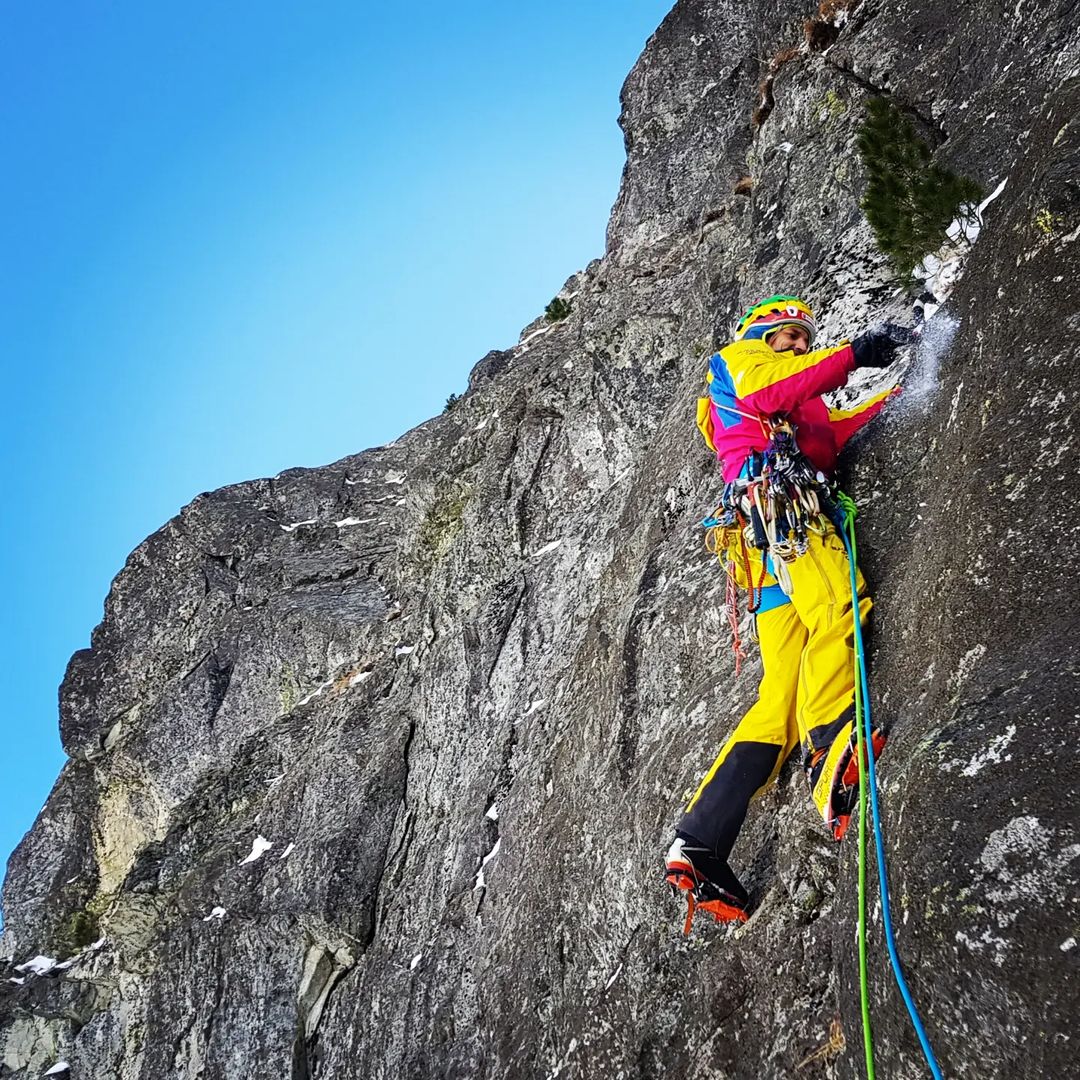 Photo: Klub Wysokogórski Kraków
 Photo: Mała Gośka Photography
Leave a comment