
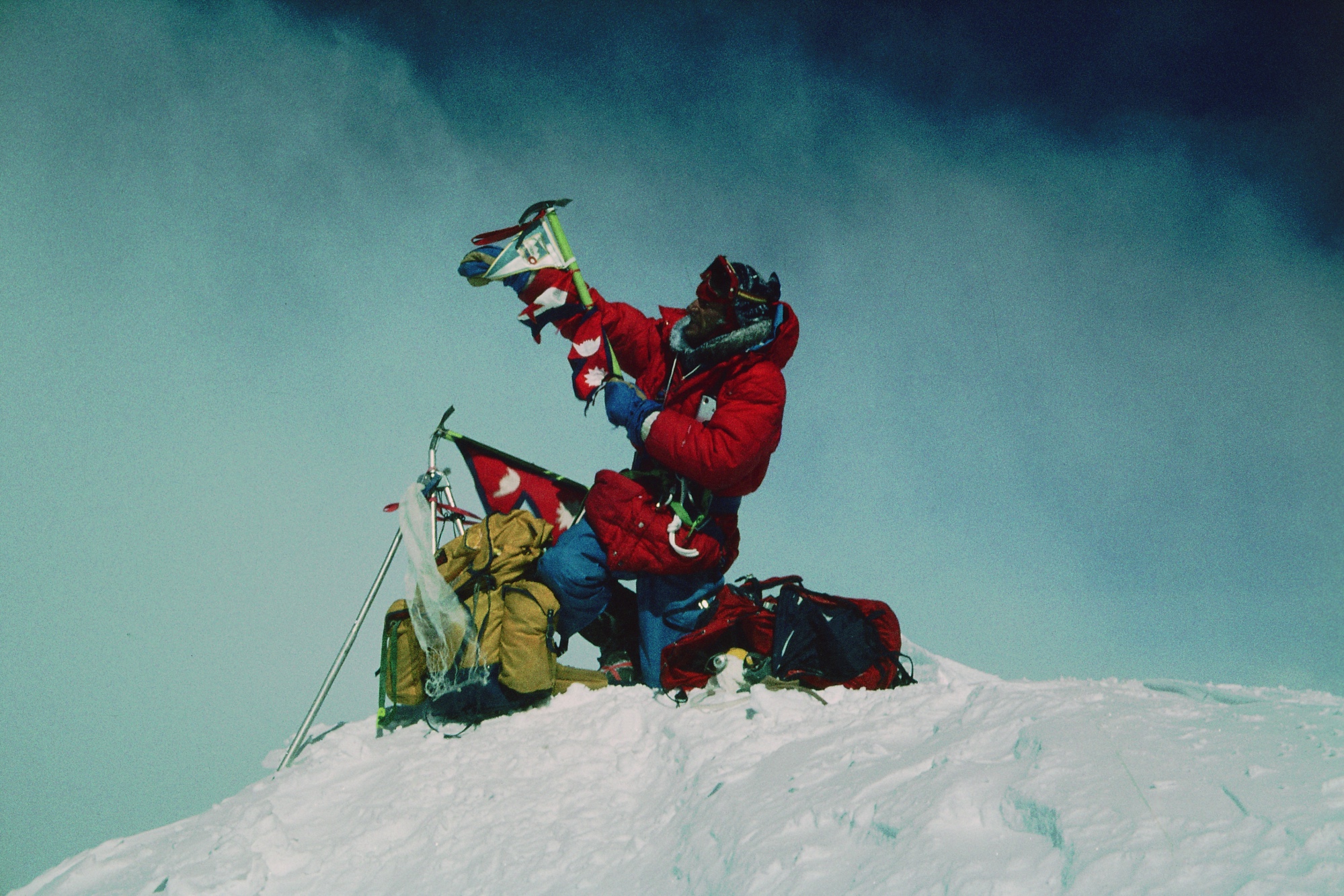
I had heard about Stipe Bozic after the first Bulgarian expedition to Everest in 1984, when five Bulgarian men climbed the summit via the West Ridge. First before them were the Yugoslavs, in 1979, and among them was Bozic. Around the 40th anniversary of "Everest 1984", some questions arose - who from where had climbed it, and one of the Bulgarians who climbed then - Nikolay Petkov, took it upon himself to summarize and analyze the data (he is expected to publish a book on the subject). I decided that I should contribute as much as I could with my work as a journalist and I did interviews with the two living members of the Yugoslav expedition - Andrej Stremfelj and Stipe Bozic (my interview with Stremfelj is also published on this site). Both were broadcast by the Bulgarian National Radio. And now - for Bozic.
===
His parents barely approve of his strange hobby when they learn of his achievements from the newspapers. In 1979, he was one of the five climbers who made the first ascent of Everest along the West Ridge, the so-called Cruel way. On the way down, he had to spend the night at an altitude of 8,300 m - outdoors, at minus 40 degrees, without a sleeping bag. In 1989, he became the second European after Reinhold Messner to climb Everest twice. In 1992, he was wounded by shrapnel during the Croatian War of Independence, and a year later he experienced his most dramatic expedition - on K2, where he barely survived.
In the beginning you didn't have the approval of your parents - what did they tell you?
Bozic: I was born in 1951 in a small village and at that time no one had heard of climbing, of mountaineering, of the Himalayas. When I started climbing in the early 1970s, my parents wondered what it was, why I was doing it, especially my father - he forbade me to climb.
Your very first big expedition was to climb Everest the hardest way - how did you prepare and what experience did you have until then?
Bozic: Before that, in 1975 I was on Mount Noshaq (7492 m) in Afghanistan, I also had some climbs in the Alps. And when I was selected for the Yugoslav expedition to Everest, they prepared a training program for us - it included rock climbing up to a certain category of difficulty, at a certain altitude, etc. In addition, we had to join another large organization - to make equipment, special shoes, tents, etc. We couldn't buy these things from a store, and we had to invent and manufacture them in our factories in Yugoslavia.
Then you climb the West Ridge, entering the Hornbein Couloir, while the first two members of the expedition went directly through the Gray Tower. Did you decide to take the couloir on the spot, or was that the tactical plan of the expedition?
Bozic: Two days before we climbed Everest, Stremfelj and Zaplotnik climbed the summit via the Gray Tower. However, there were three of us, with us was the Sherpa Ang Phu, and when I saw the steep and white part, I decided to go slightly to the left, about 50 meters away, along the Hornbein couloir. That is, we, with Stane Belak and Ang Phu, went along some variant of the West Ridge.
On the way down, the weather worsened and you had to spend the night at minus 40 degrees, at an altitude of 8300 m, without a sleeping bag. What do you remember from that night?
Bozic: During the ascent the weather was quite good, no clouds, no wind, and we were climbing with supplemental oxygen, although the bottles and masks were quite primitive at the time. On the descent, however, in the middle of the Hornbein couloir, on a small ledge, about half a meter wide (it was very steep all around), we had to bivouac. It's a real nightmare for anyone familiar with climbing in the Himalayas - it was very cold, we were out of oxygen and we were trying to make it through the night, to survive and somehow we did. But then, when in the morning we returned to the same spot from the slope, Ang Phu slipped and fell more than 2,000 meters to Rongbuk Glacier. It was a big shock for us and Stane Belak. Then I told myself that I would never go back to the Himalayas again because we had become very good friends. I was in shock all the way home. But then, you know, life goes on…
Two years after Everest, you climb Lhotse on a new route on the South Face. Although you did not reach the summit (but up to 8150 m, solo ascent), you consider this your greatest success in the Himalayas. Why?
Bozic: Because the South Face of Lhotse is a big challenge - when you see it, it's a huge, giant wall that seems impossible to climb. Then the Yugoslavs chose me to go with them and that climb was the best I have ever done. We were there for 53 days, the weather was very bad, we only had a 4-5 day window of good weather and we made it.
In 1983 you were on the Manaslu expedition where an avalanche killed Nejc Zaplotnik and Ante Bucan. What helped you to overcome the tragedy and only a year later to return to climb the summit together with the Slovenian Viki Groselj?
Bozic: We were a good team from our club in Split, Croatia. We also invited two Slovenians because we had become great friends during the expedition to Everest - Viki Groselj and Nejc Zaplotnik. During an acclimatization climb, that terrible accident suddenly happened. Then I told myself again that I would never go back to the Himalayas again, but on the descent Viki and I discussed what had happened and came to the conclusion that we could do something together, we applied for a permit and the following year we climbed the peak with him in alpine style. It was in memory of our friends.
After your successful expeditions to Everest - again, in 1989, Kanchenjunga (1991) and the Annapurna attempt (1992) you came the turn of K2 in 1993 - an extremely dramatic expedition. You gоt caught in a snowstorm, you gоt snow blindness, and one of your partners - Boštian Kekec - died. Did you think you were going to die then, or did you for some reason know you were going to survive?
Bozic: This was maybe the most dramatic expedition ever. Four of us reached the summit in very bad weather and immediately began to descend. Then with Carlos Carcolio - a friend from Mexico, we had to bivouac at over 8000 m altitude, in a storm. The next morning, when we managed to get to Camp 4, we met two people who were to attack the summit the next day. However, one of them - Boshtian Kekec, was already suffering from hypoxia and his condition was getting worse. I tried to help him, I stayed with him another night - we had neither oxygen nor any medicine. In the morning we saw that he was going to die, and we began to bring him down, in stormy winds, but there was no way we could get him down alive.
Then Zvonko Pozhgai and I began to descend in hurricane winds, we did not know where to go, I already had snow blindness, because I had to take off my glasses several times, and I could no longer see, Zvonko got frostbite on his fingers. And when we got to a steep part, we couldn't move, I couldn't see anything at all. Then he helped me by telling me where to step. When we got to a rope, I hung on to it, helping Zvonko to hang on as well, because he couldn't move his fingers. Thus, in two and a half days we reached Camp 1, where Goran Krop, a famous Swedish climber, was already waiting for us, and thus we saved ourselves.
A year earlier, you participated in the Croatian War of Independence, assisting the Croatian army in the mountainous areas. Then you were wounded by shrapnel. Which world do you think is more cruel - the war or the survival in the high mountain?
Bozic: This was another kind of danger. I never expected that a person could be my enemy. People had always been my friends, and now I had enemies against me. I knew all the Croatian mountains and felt the need to help our soldiers, my friends to cope. I also worked for television, so I combined the two things - filming and fighting.
In addition to all this, you have also been involved in caving, you have also explored the deserts...
Bozic: Because I was filming. I worked for television for maybe about 30 years and it was interesting for me to use my knowledge of climbing, for example - the use of the rope. I was filming the exploration of a vertical cave, 1400m deep. Then we reached its bottom and then the speleologists called me very often to film them. And as a mountain rescuer, I sometimes had to enter caves and rescue people.
And now? Do you keep climbing?
Bozic: Yes, but very rarely, because now climbers manage with very high categories of difficulty - for example, my daughter, eighth category and above. It's hard for me to find a partner to climb classic routes with.
What would you like to say to the new generations of climbers and alpinists?
Bozic: They have to find their way and be very careful. Once upon a time, I didn't know at first that 50% of my friends would stay forever in the mountains. People should have one thing in mind that they are constantly in danger in the mountains. Climbing and mountaineering is a big challenge and I am very happy to see someone trying to climb a steep wall in the Himalayas. There are many more peaks and big walls to climb before your generation!
===
The interview with Stipe Bozic was broadcast on May 21, 2024 on the Bulgarian National Radio: Стипе Божич: Преживях кошмара на всеки алпинист в Хималаите - (bnr.bg)
You can hear the interview in the audio file above. Photo - personal archive of Stipe Bozic
Gallery
 Stipe Bozic with Dalai Lama
 Stipe Bozic
 Antarctic
 Manaslu
Leave a comment